The prompt caching mistake that costs more than no caching at all
A changing timestamp in your prompt prefix gives you a 0% cache hit on OpenAI, so you just save nothing. On Anthropic the same line makes your bill 25% higher than if you had never cached. Measured, with a reproducible benchmark you can play with.
Here is a line that looks completely harmless at the top of a system prompt:
Current time: 2026-06-09 14:08 UTCIt is one short line in a prompt that might be five thousand tokens long. It feels like rounding error. It is not. On a cache-friendly agent that single line can be the difference between paying for about a tenth of your input and paying for all of it, turn after turn. And on one of the two providers I tested, leaving it there does something worse than waste the discount: it makes caching cost you more than if you had never turned it on.
I wanted real numbers for this, not hand-waving, so I built a small benchmark and ran it. The short version: where you put the things that change decides your prompt-cache bill, and the penalty for getting it wrong is not the same across providers. Let me show you what is actually happening, and then you can play with the live numbers at the bottom.
What prompt caching actually caches
To understand the footgun you have to know what is being cached, and it is not “the text of your prompt” in any literal sense. It is the model’s intermediate work on that text.
When a model reads your prompt, it runs a phase called prefill. It pushes the whole prompt through the network in one pass and, for every token, computes a pair of vectors called the key and the value at every layer. Those key and value vectors are what attention reads from when it generates the next token. The collection of them is the KV cache. Prefill is the expensive part of serving a long prompt, because it is compute-bound: the GPU is doing dense matrix math across your entire input, and the attention work climbs quickly as the input gets longer. Generating the output afterwards is a different shape of work, one token at a time, limited by memory bandwidth rather than raw compute.
Prompt caching is the provider keeping that precomputed state for a prefix of your prompt so that the next request with the same prefix can skip prefill for those tokens. The official docs stay out of the internals, OpenAI and Anthropic both describe it simply as resuming from a cached prefix, but the prefix state they reuse is exactly this KV cache. Either way the billing follows the same logic: you are not paying to recompute attention over five thousand tokens again, you are paying to fetch state that already exists, which is why a cached input token costs roughly a tenth of a normal one. You are buying a memory read instead of a recomputation.
Now the important part, the part that makes the timestamp matter. Attention is causal, so the key and value vectors for a token depend on every token before it. Change one token near the start and every vector after it is different. The cache is matched as a prefix from the very beginning, and on today’s systems that match has to be identical, block for block, up to the point where it diverges. So a single changed token early in the prompt does not invalidate “a bit” of the cache. It invalidates everything from that point on. In the naive runs below, the prompt is almost entirely identical from turn to turn and the cache still does nothing, because the part that moved is at the top.
A timestamp at the top of a system prompt is exactly that: one small thing that changes on every request, sitting in front of everything that does not.
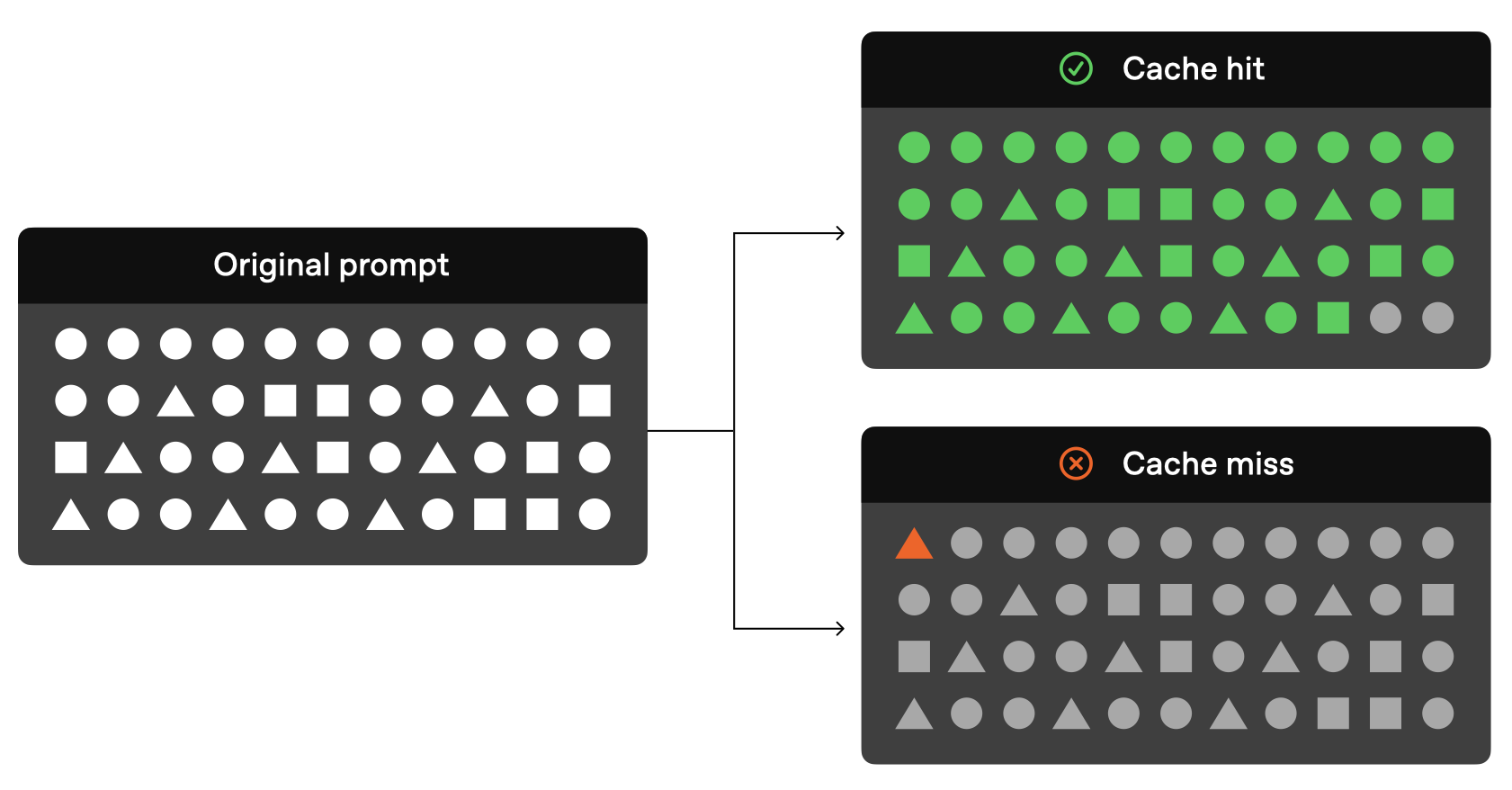
OpenAI’s own picture of the same idea: an identical prefix is a cache hit (green), but change the very first element and it is a miss (orange), greying out everything after it. Source: OpenAI, Prompt caching.
The test
I needed a workload with the shape that caching is supposed to reward: a big, stable prompt and a small, changing payload each turn. A dungeon master for a text adventure is perfect. The system prompt is a few thousand tokens of fixed world rules, tone, and lore that never change. Each turn the only genuinely new things are the player’s action and the in-world time.
I ran the same six-turn session two ways, changing one thing only: where the timestamp goes.
- Naive: the changing timestamp sits at the top of the system prompt, above the stable lore.
- Disciplined: the system prompt is the stable lore and nothing else, and the timestamp rides in a small wrapper on the latest user message, at the very end.
Same information, same task. The only variable is placement. Everything ran through OpenRouter so I
could read the real billed cost and the cached-token counts straight from the response, with
reasoning turned off so it would not muddy the token counts. Models and prices are pinned to the run
date, 2026-06-09: OpenAI gpt-5.4 and Anthropic claude-sonnet-4.6. I tried Gemini too, but its
implicit caching did not surface measurable cache hits through OpenRouter, so I left it out rather
than publish a number I could not reproduce.
The concrete shape, so you can judge it: the system prompt is about 5,000 tokens of fixed rules and lore on OpenAI’s tokenizer, around 6,300 on Anthropic’s denser one. The only thing that changes each turn is the player’s action and the timestamp, together roughly thirty to sixty tokens. Because the whole conversation is re-sent every turn, a six-turn run ships about 33,000 input tokens on OpenAI and 40,000 on Anthropic. This is one workload on two models, not a universal constant. The exact percentages move with prompt size, model, provider, and pricing. The direction does not.
The results
| Timestamp in the prefix (naive) | Timestamp in the tail (disciplined) | |
|---|---|---|
| OpenAI gpt-5.4 | +0% vs no caching. 0% cache hit, you save nothing | −82% input cost, ~92% of input served from cache |
| Anthropic claude-sonnet-4.6 | +25% vs no caching. You pay more than if you never cached | −68% input cost, ~81% from cache |
Every percentage is against the same run with caching off, the no-cache baseline. So −82% means the disciplined run paid 82% less on input than sending those identical prompts with no caching, and +25% on Anthropic means naive caching cost a quarter more than not caching at all.
Read the naive column twice, because the two cells are not the same kind of bad.
On OpenAI, naive caching is a non-event. Caching is automatic, there is no extra fee to write to the cache, so the worst that happens is you never get a hit. You pay full price, exactly what you would have paid with no caching at all. The discount is sitting right there and you are walking past it. Annoying, but free.
On Anthropic, naive caching is a tax. This is the part people miss. Anthropic caching is something you opt into, and writing to the cache is not free: at the time of this run a cache write cost 1.25 times a normal input token (the short five-minute cache; the one-hour cache is 2x). The deal is that you pay a small premium once to store the prefix, then read it back at a tenth of the price many times, and you come out ahead after the very first read. But if your prefix changes every turn, you never get the read. You pay the write premium, throw the entry away, and write a fresh one next turn. Over my six turns that worked out to about 25% more than if I had left caching off entirely. You turned on the feature that is supposed to save money and it charged you for the privilege of wasting it. If you go looking for this in your own bill, watch the cache-write count and not just the reads, because that is the field it hides in.
The disciplined column is the happy ending, and it is the same move on both providers: pull the timestamp out of the prefix. Suddenly the entire system prompt is byte-for-byte identical across turns, the cache hits on every turn after the first, and input cost falls off a cliff. The first turn still pays full freight because the cache is cold, then it is mostly reads from there. Same task, same information in front of the model, a fraction of the bill.
How to not do this
The fix is a habit, not a library. Order your prompt from least likely to change to most likely to change, and never let anything volatile sit above something stable.
In many agent setups that falls out naturally from how the request is assembled: tools, then the system prompt, then messages, which is already roughly stable to volatile. Keep the per-request content at the very end. A timestamp, a request id, a per-user greeting, a freshly retrieved document: all of it goes after the stable block, ideally on the last user message. If you genuinely need the current time in the model’s view, put it in the last message, not the system prompt. The model still sees it. The cache still holds.
Retrieval is the trap worth calling out, because it is so common. A lot of RAG setups paste freshly retrieved passages in near the top, ahead of the stable instructions. If those passages change every request, and they usually do, they break the cache for everything below them in exactly the same way the timestamp does. Put retrieved context after the stable block, not in front of it.
Two more things from the provider docs are worth keeping in mind. Caching only engages above a minimum prompt size, 1,024 tokens on the models I used here, so very short prompts never cache no matter how you order them. And the timestamp is not the only way to break a prefix: changing your tool definitions, toggling a tool on or off, or adding an image earlier in the prompt invalidates the cache the same way, and on Anthropic even reordering the keys in your tool JSON can do it, which has caught out people whose language serializes JSON in random key order. The rule underneath all of these is the same. Anything that changes the bytes of the prefix throws away the cache below it.
A useful way to think about it: your prompt has regions with different lifetimes. The persona and rules live for the life of the deployment. Per-conversation context lives for the session. The current turn lives for one request. Stack them in that order and the cache boundary falls in the right place on its own.
Play with it
This is the part worth your two minutes. Below is the recorded run, replayed. Flip the timestamp between the prefix and the tail, switch providers, and step through the session while the bill updates. Watch the prompt stack go red when the prefix is poisoned and green when it caches, and watch the Anthropic naive bill climb above the no-cache line. It also runs full screen at cache.neuromancer.in.
Takeaway
Prompt caching is one of the cleanest wins in production LLM work. It can take eighty to ninety percent off your input bill for the kind of agent that re-sends a big stable prompt every turn, and that is most agents. But the win is conditional on one discipline: keep the things that change out of the part you want cached. Get it right and you barely think about it again. Get it wrong on a provider that charges to write the cache, and you are paying extra for a feature you believe is saving you money.
Look at where the moving parts of your prompt are. If a timestamp, an id, or a freshly fetched chunk is sitting up top, move it down. Then check your cache-read and cache-write counts and confirm the reads are happening. The discount is generous. You just have to stop standing in front of it.
Going deeper
The two official guides are worth reading in full for the exact rules on your models, and they are where I checked the pricing multipliers, the minimum sizes, and the prefix-matching behavior used above:
The benchmark and the interactive replay live in one small repo: github.com/rnaidu-parallel/prompt-cache-economics. Clone it, add an OpenRouter key, and run the same session against your own models.